What should you send first?
Start with product dimensions, a reference image, the available display space, quantity and delivery destination. Add any fixed branding, lighting or deadline requirements. Mark unknown details so the development team can propose options and identify what still needs confirmation.
You can begin at several levels of detail.
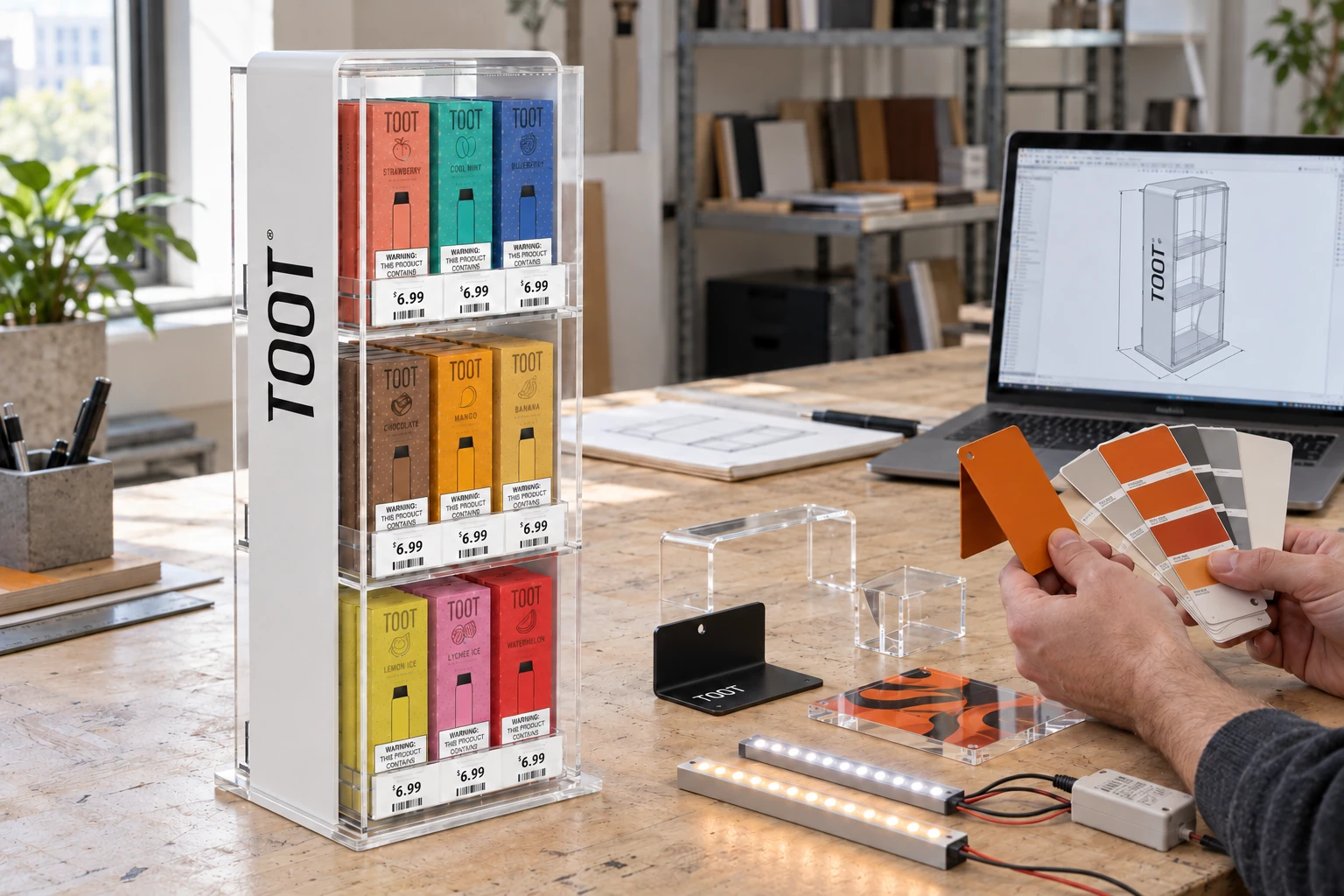
Some buyers arrive with an existing display they want to adapt. Others have a hand sketch, a product screenshot or a set of packaged products. Each is a useful starting point for a custom acrylic vape display, countertop stand or floor cabinet.
Explain what you want to keep from a reference: its number of shelves, its footprint, the illuminated header or the way products are divided. A photograph alone leaves those priorities open to interpretation. Include a ruler in product photographs where useful, and send measurements with units.
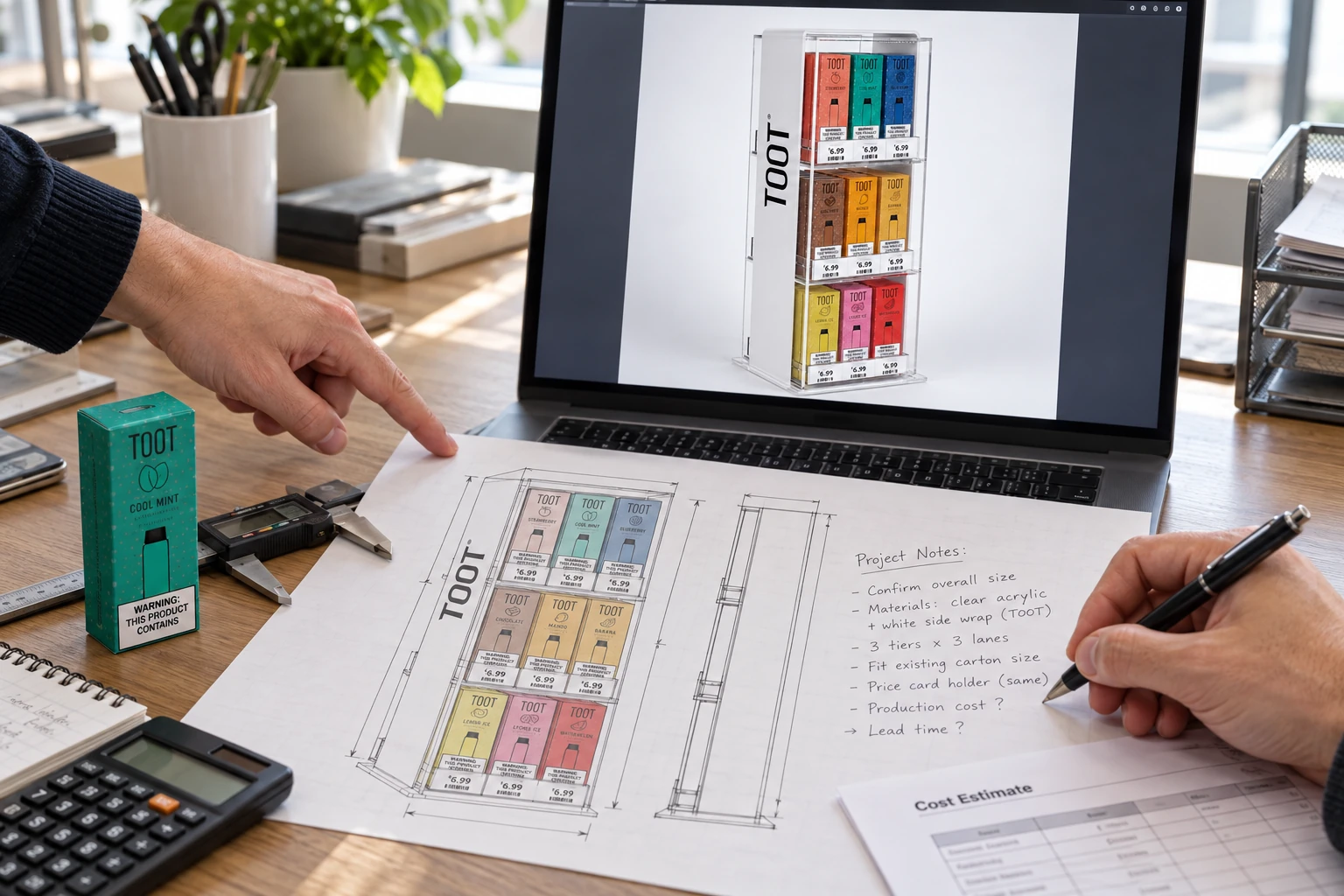
If you already have a 3D model, share the current revision along with any drawings. Geometry and written details serve different purposes: a model shows the shape, while drawings can clarify dimensions, hardware and finish requirements. Protolabs’ quoting guidance illustrates why supplementary drawing details matter in fabrication.
Prepare the details that change the design.
| Include | Useful detail | Why it matters |
|---|---|---|
| Products | Pack dimensions, weight, SKUs, facings and units per lane | Sets shelf spacing, usable capacity and support requirements |
| Retail position | Counter or floor, maximum footprint, access and refill direction | Defines the overall size and how staff use the fixture |
| Finish & branding | Logo files, artwork, colour references and print locations | Connects the structure to the visible brand application |
| Lighting | White light or colour effects, dimming, plug destination and cable exit | Reserves space for LEDs, power components and access |
| Order & delivery | Quantity per design, destination, target date and assembly preference | Helps scope sampling, packing and shipping options |
If the products are still being developed, identify which dimensions are provisional. Design around an agreed envelope and flag the point at which final packaging dimensions must be confirmed. This is especially useful when a display needs individual product slots or close-fitting dividers.
Ask for a quote with a clear scope.
At Billionways, we aim to quote within 24 hours once the core project details are confirmed. An incomplete reference may need a few questions first. A complex material combination or unresolved component can also require further review before that part of the quote is firm.
Check what the quotation includes: the display construction, decoration, lighting and power components, sample development, packaging and any proposed assembly work. Identify whether freight is included or quoted separately, and record the destination and shipping assumptions.
Useful alternatives should answer a real question. For example, compare an assembled unit with a knock-down version, or a metal cabinet with acrylic shelves against an all-acrylic countertop concept. Keep the stock capacity and decoration requirements consistent so the comparison remains meaningful.
Bring the different production tasks into one specification.
A single display may need acrylic bonding and heat bending, folded metal panels, powder coating, printed graphics and LED installation. Those components have to fit together. A change to the metal shell can affect the acrylic tray clearance, the printed panel size and the packing insert.
Billionways coordinates the project with selected production partners. The practical value is a shared brief, a coordinated revision and a clear list of approvals across those tasks. Protocase’s fabrication guides provide useful background on the separate decisions involved in bends, fasteners, finishes and graphics.
During model review, check the product layout, access openings, cable route and replaceable components. For colour-sensitive metalwork, request a physical finish sample against the agreed reference. Keep the latest drawing, artwork and finish approval under a consistent revision name.
Use the physical sample to test the working details.
A 3D model helps everyone understand the proposal. The physical sample lets you check how it feels and functions with the actual products. Load it as intended, remove and replace stock, and inspect the areas that staff will handle repeatedly.
Review before signing off
- Overall footprint, shelf clearances, dividers and product fit.
- Joints, edges, coating, print placement and visible colour.
- Doors, drawers, fixings and refill access where specified.
- Lighting with the products in position and store-like ambient light.
- Cable exit, power-component access and installation instructions.
- Stability and the agreed load arrangement.
Record requested changes as one marked set of notes with photographs. Confirm which changes require an updated drawing or sample. An approval should identify the exact revision being accepted, including any agreed exceptions.
Develop the packing while the sample is available.
Decide whether the fixture will travel assembled or in separate parts. Foam or EPE cushioning with a carton can be considered around the display geometry; larger or heavier units may need additional protection. Exposed acrylic corners, projecting headers and loose hardware each need attention.
FedEx’s breakable-item packing guide stresses appropriate cartons and cushioning. For a custom display, the protection must also be checked against the actual fixture and route. A carton specification alone does not establish that a particular packed display has passed a transport test.
A knock-down structure may reduce packed volume, but it introduces assembly steps and separate components. Compare the packed dimensions, component protection and store assembly work before choosing it. Ask for an assembly check and a complete parts list.
If several designs will ship together, send quantities per design and the proposed destination. We can review consolidation and sea, air or express options with the shipment requirements. Container utilisation and freight costs depend on the confirmed carton sizes, weights and route.
Release production against an agreed record.
Before batch production, bring the approved drawing, artwork, finish, lighting configuration, sample notes and packing specification together. Confirm quantities per design, carton marks and the checks to be recorded before dispatch.
Agree when you will receive progress photographs or inspection records, and what happens if a detail needs clarification. A clear release record gives the coordinator and each production partner the same version to work from.
A useful first message.
We need a countertop display for [product type]. The packaged product is [width × depth × height, units] and weighs [weight]. We would like [facings × stock depth] within a footprint of [size]. Quantity: [units per design]. Branding/lighting: [requirements]. Destination and target date: [details]. Attached are [reference photo, sketch or model]. We would like advice on [open questions].
Send what you have and mark what is still open. You can choose an existing display format as a starting point, read the material selection guide, or share your brief with our team.
Further reading
These resources explain the fabrication and packing principles referenced above. The brief and approval checklist reflects Billionways’ project-coordination approach.